The Accountability Journal for Men Who Keep Starting Over
The Accountability Journal for Men Who Keep Starting Over
You don't need someone to hold you accountable. You need a system that doesn't forget.
Every man who's hired a coach, joined a group chat, or texted a friend "I'll have it done by Friday" knows how this ends. External accountability works until the person stops checking. Then you're back where you started — except now you feel worse about it.
The Real Accountability Problem
Accountability isn't a personality trait. It's a structural problem.
Most men fail to follow through not because they lack commitment, but because they never built a system that makes their commitments visible. The plan exists in their head. The week passes. The plan disappears. And the gap between intention and execution becomes a pattern they've quietly accepted as normal.
That pattern isn't a character flaw. It's a design flaw. You can't be held accountable to something you can't see.
There's no record of what you said you'd do. No evidence of where you actually spent your time. Nothing to look back on and say: this is where it keeps falling apart. Without that data, every week starts fresh with the same good intentions — and ends the same way.
Why External Accountability Breaks Down
External accountability is a temporary fix for a structural problem.
When someone else tracks your progress, you perform for them — not for yourself. The moment they stop checking, the behavior follows. This is why gym partners work until they don't, and why men who hit goals inside a group often lose them once the group ends.
The goal isn't to feel motivated by someone watching you. The goal is to build a system that works when no one is watching. That's a completely different thing — and it's the only kind of accountability that compounds over time.
You can't outsource it. You can only build it.
What an Accountability Journal Actually Does
An accountability journal doesn't cheer you on. It records reality.
Every morning, you write what you plan to do. Every evening, you write what actually happened. That gap — between plan and reality — is data. Over 30, 60, 90 days, patterns emerge. You start to see exactly where your weeks fall apart, what conditions produce your best work, and what you've been lying to yourself about.
This is what no external coach can give you. They observe from the outside. A journal gives you access to your own behavior at a resolution no other tool matches. It's ruthlessly honest in a way that a conversation with a friend never is.
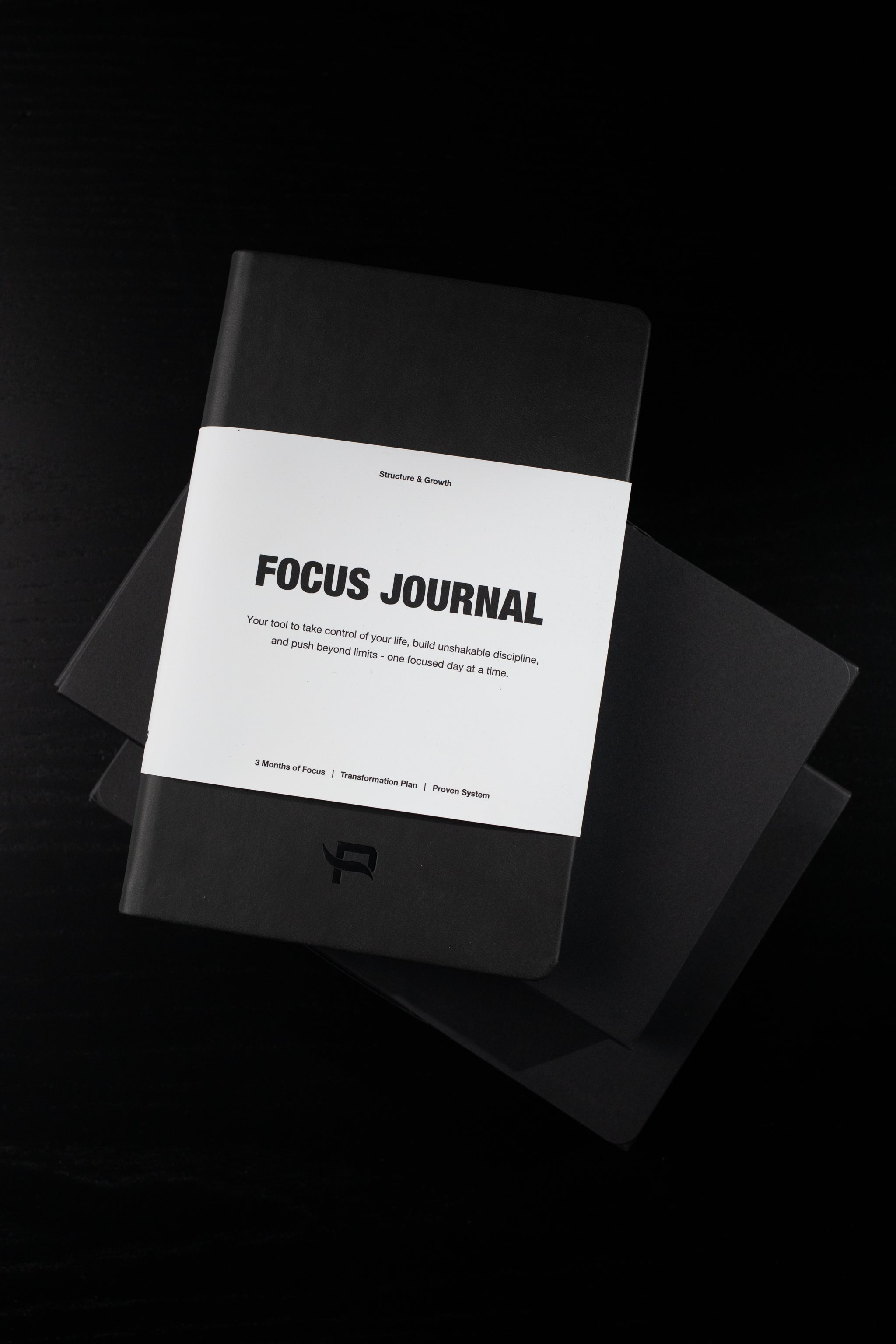
The PrimeFlow Journal is built around this exact mechanic: daily priorities in the morning, evening reflection at night, weekly review every Sunday. Not for motivation. For clarity. Structure that holds even when the feeling doesn't. If you want to understand why this outperforms motivation-based systems, read why motivation doesn't work first — it explains the foundation.
5 Rules for Building Real Accountability
1. Write three priorities every morning — maximum.
Not a to-do list. Three things. If you complete only those three, the day was a success. This constraint forces honesty. You can't deceive yourself about what's actually important when you're limited to three items. Anything beyond that is noise you've tolerated.
2. Review every evening — especially when the day was bad.
If you only journal on good days, you only have data from good days. The sessions where things fell apart contain the most useful information. Five minutes: what got done, what didn't, and one honest sentence about why. That single sentence, repeated over weeks, shows you the real pattern.
3. Name the outcome, not the intention.
"Work on the project" is an intention. "Write the first 400 words of the proposal" is an outcome. Intentions slip. Outcomes are binary — they happened or they didn't. When you write vague goals, you can always convince yourself you partially succeeded. Specific outcomes eliminate that exit.
4. Do a weekly review every Sunday.
Look at the full week: what patterns appeared? What kept getting pushed to tomorrow? Where did your attention actually go versus where you intended it to go? Most men skip this step entirely. It's the only step that turns daily data into actual behavior change. Without it, you're logging without learning.
5. Commit to 90 days, not to next week.
A single bad week is noise. A pattern across twelve weeks is a signal. Most accountability systems fail because they reset too often — weekly goals fall apart, monthly check-ins disappear. Ninety days is long enough to build real momentum and short enough that every passing week carries weight. The cost of a wasted week becomes visible in a way it never is inside an annual plan.
Want the system behind this?
I put together a free guide — 7 rules that replace external accountability with an internal structure that actually holds. The foundation behind this journal approach.
Get the Free Guide →The Man Who Holds Himself
External accountability always has a single point of failure: the other person's attention.
The men who execute consistently don't have better accountability partners. They've built better internal systems. They've made honesty with themselves a daily habit — writing what they planned, writing what happened, and adjusting based on the gap. Not once a month in a check-in call. Every single day.
That's what an accountability journal does. Not inspiration. Not motivation. Just structure, applied daily, for 90 days, until the behavior becomes default.
If you're tired of starting over, stop looking for someone to watch you. Build the system that watches itself.

The PrimeFlow Focus Journal
90 days · Daily priorities · Weekly review · Evening reflection
A5 · Lay-flat · 100gsm · Vegan leather softcover · €37
Get Your Journal — €37 →